The calculation of critical value α (see segregation prediction technique), has been validated using both, data published in various technical papers [8], [9], [10], [11], [12], [13] and in industrial conditions with several companies using the results of ultrasonic test for over 50 ingots with weights between 5 to 220 tones.
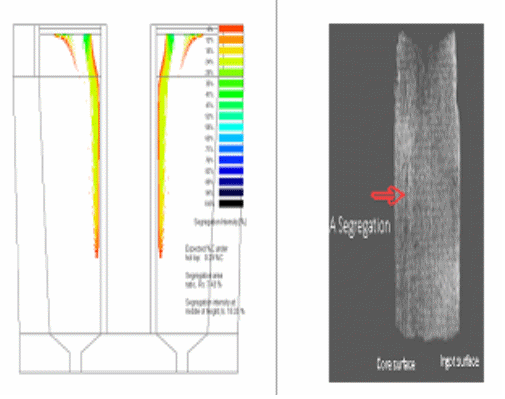
Bellow is a validation of the segregation prediction technique made by comparing the sulphur print of a 20 tones carbon steel cut hollow ingot [11], Figure. 1.b with the segregation distribution on the transverse section we got by simulation, Figure 1.a. Please note that in Figure 1, the sulphur print is made only on a half of the ingot section.
|
|
|
a) A segregation simulation b) Sulphur print in cut ingot [11] Figure 1. A segregation in carbon steel 20T hollow ingot |
As
we see in Figure 1, the position and size of A segregation in
modelled distribution, Figure 1.a are practically the same as in the
cut ingot,
Figure 1.b; a good agreement between simulation and real data.
References
[1] Industrial Soft: Online Ingot Mould Design Assistant v.1.0, www.simcade.com
[2] Industrial Soft: SIMCADE v.2.0, Solidification Simulation Software; www.simcade.com
[3] Flemings, M.C.: Our Understanding of Macrosegregation: Past and Present, ISIJ International, Vol. 40 (2000), No. 9, pp. 833–841, 2000
[4] Delorme, J.; Laubin, M., Maas H.; Solidification of Large Forging Ingots, Casting and Solidification of Steel vol.1, ECSC Luxembourg 1977
[5] Lesoult G.: Macrosegregation in steel strands and ingots: Characterization, formation and consequences, Mater. Sci. Eng. A, 413-414 (2005), pp. 19-29.
[6] Kajikawa K., Suzuki S.: Development of 650-ton-class ingot for turbine rotor shaft forging application, ICRF, 2012
[7] Suzuki, K.; Miyamoto, T.: Formation Condition of “A” Segregation, Tetsu-to-Hagane. 63. 53-62, 1977
[8] Yamada, H.; Sakurai T.; Takenouchi, T.: Critical Conditions for the Formation of A-Segregation in Forging Ingots; ISIJ, 1989, p.92-104
[9] Suzuki, K.; Miyamoto, T.: Influence of Alloying Elements on the Formation of A-Segregates In Steel Ingots, Tetsu-to-Hagane, 1979 Volume 65 Issue 10 Pages 1571-1580
[10] Yamada H., Sakurai T., Takenouchi T.: Appearance of "A" Segregation in Forging Ingots and Influencing Factors, 1989 Volume 75 Issue 1 Pages 105-112
[11] Iida Y. et al.: Development of Hollow Ingot for Large Forging, Tetsu-to-Hagane 1980 Volume 66 Issue 2 Pages 211-220
[12] Haida, O.; Okano, S.; Emi, T.; Kasai, G.: Estimation of the Formation of A-Segregation in Steel Ingot in Terms of the Chemical Composition of Steel; ISIJ, 1981, p.954-958
[13] Suzuki K., Taniguchi K.: The Elimination Mechanism of A-Segregates of Steel Ingot, 1979 Volume 65 Issue 10 Pages 1581-1588
[14] Martin Balcar et all : Developing and Testing a New Type-8k Mould For Tool-Steel Ingot Casting, Materials and Technologies 42(1):33-38 • January 2008