The segregation in the columnar zone is much influenced by the cooling and solidification rate. To define the A-segregation occurring conditions K. Suzuki and T. Miyamoto proposed the following equation, based on solidification rate R (mm/mm) and cooling rate ɛ (°C/min):
ɛR1.1
≤ α
They have investigated at Muroran Research Centre, The Japan Steel Works Ltd. (JSW) a 0.7 % carbon steel and obtained α = 8.75, the critical value of A-segregation appearance; α is a value established experimental and depends strongly by chemical composition.
Using laboratory experimental data we have developed a mathematical model to evaluate and asses the critical value α, the value at which the A-segregation starts to appear. The model takes into account the solidification limits, change in density of solutes at the solidification front and the chemical composition of the steel (C, Si, Mn, P, S, Ni, Cr, Mo and V).
At the moment our mathematical model is applicable to Cr-Mo, Ni-Mo, Ni-Cr-Mo-V, Mn-Ni-Mo and carbon steels. More experiments must to be done to cover other steels.
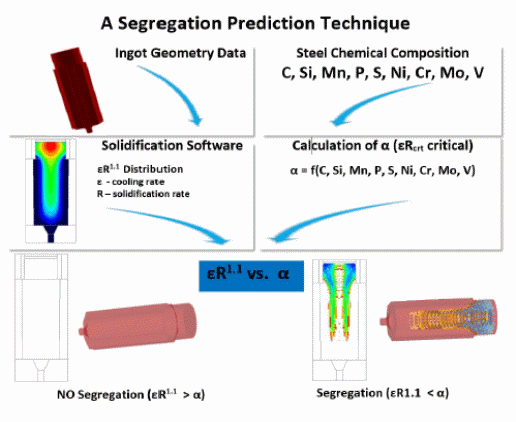
Figure 1. A-segregation prediction technique
In
Figure 1 is presented the flowchart of technique we have developed to
model the A-segregation in steel ingots. In this flowchart there are
two branches:
- the left branch calculates, by simulation, the cooling
and solidification rate. This branch, that has as input data the
ingot geometry taken from the ingot design software, calculates using
solidification simulation software the cooling and solidification
rate.;
- the other branch calculates, using the chemical composition,
the critical value α, the value at which the A-segregation will
appear.
Then, the software compares the values we got from both
branches and plots the segregation area in regions that contain
values below the critical value.
Here,
we have two situations:
- in the first case, if the solidification rate
is bigger than the critical value α, as seen in the bottom left
side example, we do not have segregation;
- in the second one, if the
solidification rate is lower than the critical value α, we will
have A-segregation and its intensity depends on the difference
between local ɛ•R1.1and
critical value α.
To
asses quantitatively the influence of various variables on
A-segregation, we have defined the parameter Rs, the ratio between
area affected by A-segregation and the longitudinal section area of
the ingot body.
More, because in controlling the A-segregation it is important not only the area of segregation but also the size and distribution of segregates inside the segregation area, we defined the parameter Is, Intensity of A-segregation, as difference between the critical value α and local ɛ•R1.1. These values will be shown in every solidification analysis report of the handbook.