Macrosegregation type
commonly known as A-segregation, Figure 1, presents channels enriched
by sulphur, carbon, phosphorus and is one of the factors that has a
critical impact on the mechanical properties of the final forging
product and one of the reasons why the forged product can be rejected
at the ultrasonic test.
-
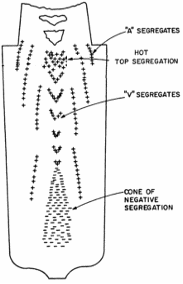
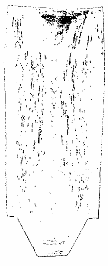
Figure 1 Macrosegregation in
steel ingots [3]
Figure 2. Sulphur print in
cut ingots [7]
A-segregation forms in the zone of columnar grains at the regions with structure characterized by the transition from the columnar to large equiaxed grains and is often accompanied by porosity.
This
defect is due to the shrinkage process during phase transformation
combined with a simultaneous redistribution of impurities in the
two-phase zone during the solidification process. The main cause of
A-segregation is the relative movement of segregated liquid during
solidification. Most elements have a lower solubility in solid than
in liquid phase as is shown by phase diagrams. During solidification
process, the solutes are rejected into the liquid phase, leading to a
continual enrichment of the liquid and lower concentrations in the
primary solid. By this mechanism, the size of A-segregation may be,
function by solidification conditions and ingot size, from several
millimetres to centimetres or even meters as shown in sectioned
ingots [4], [5], [6], and Figure 2 [7].
Because of the low diffusion
of the solutes in the solid state and the large distances involved,
macro segregation cannot be removed after the solidification is
completed.
References
[1] Industrial Soft: Online Ingot Mould Design Assistant v.1.0, www.simcade.com
[2] Industrial Soft: SIMCADE v.2.0, Solidification Simulation Software; www.simcade.com
[3] Flemings, M.C.: Our Understanding of Macrosegregation: Past and Present, ISIJ International, Vol. 40 (2000), No. 9, pp. 833–841, 2000
[4] Delorme, J.; Laubin, M., Maas H.; Solidification of Large Forging Ingots, Casting and Solidification of Steel vol.1, ECSC Luxembourg 1977
[5] Lesoult G.: Macrosegregation in steel strands and ingots: Characterization, formation and consequences, Mater. Sci. Eng. A, 413-414 (2005), pp. 19-29.
[6] Kajikawa K., Suzuki S.: Development of 650-ton-class ingot for turbine rotor shaft forging application, ICRF, 2012
[7] Suzuki, K.; Miyamoto, T.: Formation Condition of “A” Segregation, Tetsu-to-Hagane. 63. 53-62, 1977
[8] Yamada, H.; Sakurai T.; Takenouchi, T.: Critical Conditions for the Formation of A-Segregation in Forging Ingots; ISIJ, 1989, p.92-104
[9] Suzuki, K.; Miyamoto, T.: Influence of Alloying Elements on the Formation of A-Segregates In Steel Ingots, Tetsu-to-Hagane, 1979 Volume 65 Issue 10 Pages 1571-1580
[10] Yamada H., Sakurai T., Takenouchi T.: Appearance of "A" Segregation in Forging Ingots and Influencing Factors, 1989 Volume 75 Issue 1 Pages 105-112
[11] Iida Y. et al.: Development of Hollow Ingot for Large Forging, Tetsu-to-Hagane 1980 Volume 66 Issue 2 Pages 211-220
[12] Haida, O.; Okano, S.; Emi, T.; Kasai, G.: Estimation of the Formation of A-Segregation in Steel Ingot in Terms of the Chemical Composition of Steel; ISIJ, 1981, p.954-958
[13] Suzuki K., Taniguchi K.: The Elimination Mechanism of A-Segregates of Steel Ingot, 1979 Volume 65 Issue 10 Pages 1581-1588
[14] Martin Balcar et all : Developing and Testing a New Type-8k Mould For Tool-Steel Ingot Casting, Materials and Technologies 42(1):33-38 • January 2008